June 3, 2026
The Mid-Year Marketing Reset: 7 Low-Cost Moves Smart SMBs Run Before July 1

Read time: ~6 minutes
If your small-business marketing has been on autopilot for two quarters and the results have been flat, the seven moves below run under $1,000, can be executed in a single week of focused effort, and produce inbound activity you can measure within 60 days. None of them require an ad budget. None of them require a marketing department. All of them are physical, neighborhood-facing, and most of your competitors aren’t running them.
We see this every June at the counter: small-business owners walking in to print “one quick thing” and leaving with a four-piece marketing reset for the second half of the year. Here’s what that reset looks like.
January marketing plans tend to be ambitious. June marketing reality tends to be: the website never got refreshed, the postcards never got mailed, and the storefront sign is the one from 2023. The mid-year moment is when most owners either course-correct or quietly give up on the plan they wrote in January.
The good news: a mid-year reset doesn’t require redoing the plan. It requires running the four or five physical-marketing moves that compound through the second half of the year — the ones that produce results in Q3 and Q4 because they’re set up in June.
Expected outcome: 4–9% response rate (industry data; we see this consistently at the counter)
Direct mail to your existing customer list is the highest-response marketing move available to most small businesses: 74% of marketers report direct mail provides the best ROI compared to other channels. The reason it works: a postcard sits on a desk or fridge for a week, while an email sits in an inbox for 30 seconds. The medium changes the half-life of the impression.
The setup: Provide your local PostNet with a list of your customers from the last 12-24 months (a spreadsheet of past invoices works). Work with the PostNet to create a target offer and eye-catching design. The PostNet can print and help you mail the pieces out.
Time to execute: 1 week from design approval
Expected outcome: every passing impression for the next 3–5 years
The physical sign at your storefront, your job site, or your event booth earns impressions every day with no recurring cost. If yours is faded, peeling, or two phone numbers out of date, you’re losing inbound calls every week. A refreshed sign with the current phone number, the current service categories, and a clean design is the single highest-ROI piece of physical marketing a service business can run.
For storefront businesses, refreshed storefront signage produces measurable foot-traffic lift inside 30 days.
Time to execute: 1 week
Expected outcome: 5–15 referred inbound contacts per quarter from a single drop
Business cards are still the cheapest physical marketing in existence, and the part most owners miss is leaving stacks in the right places. A coffee shop next to your office, a gym across the street, a bookstore down the block — most local businesses are happy to keep a small stack of cards from a friendly neighbor on a counter or community board.
The setup: refresh the design (clean, current contact info, one clear value proposition), print 500, and drop stacks of 50 of them next door this month. You don’t need to overthink which neighbor — pick one that shares your customer demographic.
Time to execute: 1 week
Expected outcome: 8–15% repeat-purchase lift on the next order
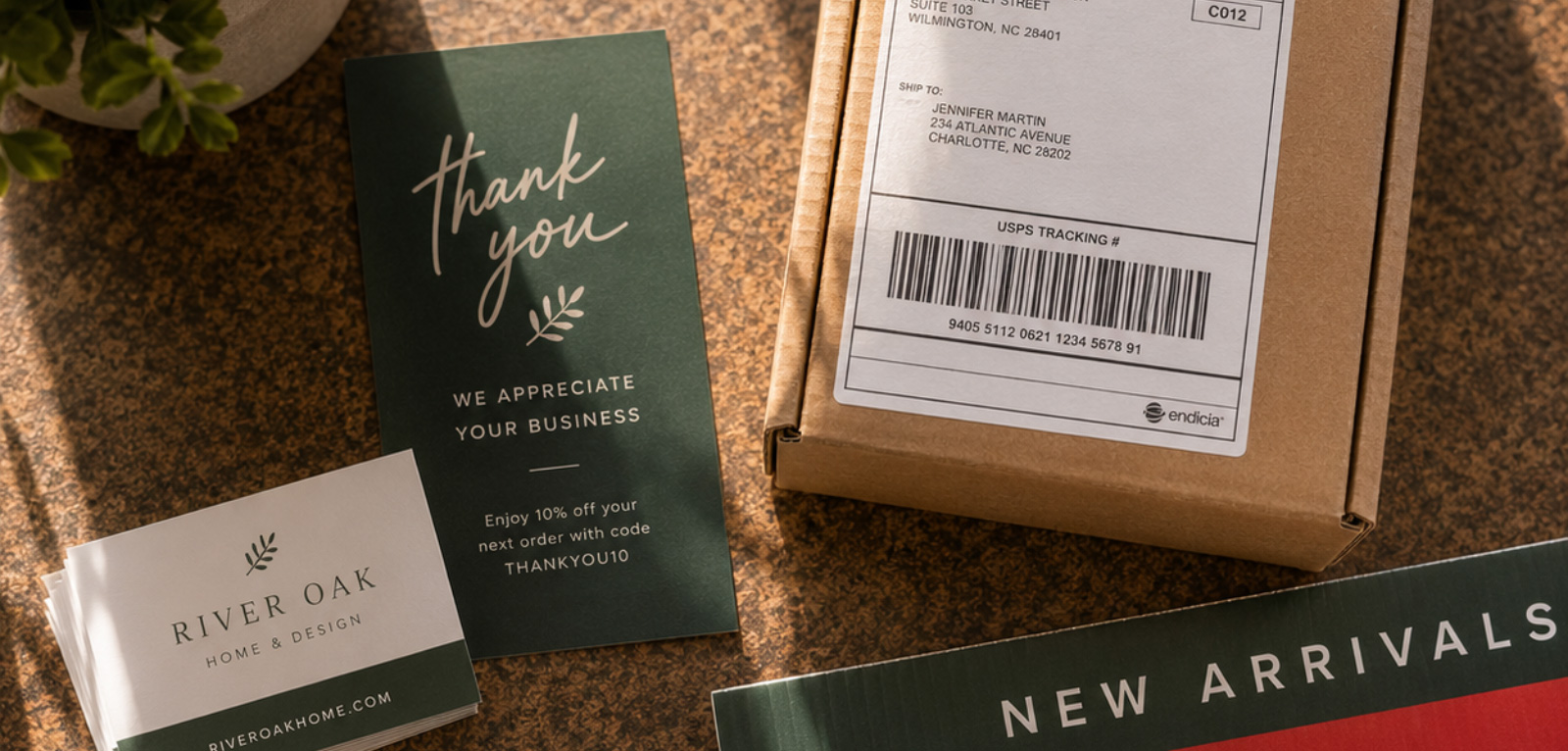
Every shipped order is an opportunity to make the next sale, and most small-business owners ship a plain box with no follow-on. A 4×6 thank-you insert with the customer’s name (or a simple “Thank you”), a 15% discount code for the next order, and a request to share on social produces a measurable repeat-purchase lift inside 60 days.
This move costs less per customer than a coffee. It’s also the lowest-effort move on this list — design once, print 250, and slip one in every order for the next quarter.
Time to execute: 2 hours of list pull + 1 week of print and mail
Expected outcome: 3–8% reactivation rate on customers who haven’t ordered in 12+ months
Most small-business owners don’t realize how much of their database has gone cold. Customers who bought twice, then nothing for a year, are the cheapest possible source of new revenue — they already know you.
The setup: pull a list of customers who last ordered 12–24 months ago, design a postcard with a small reactivation offer (“We’ve missed you — 20% off your next order through July 31”), and mail it. The response rate on lapsed-customer mail consistently outperforms cold acquisition mail by 4–6x.
Time to execute: 1 week
Expected outcome: 30–80 new local impressions, plus relationship credit with the host
Find one local event between now and Labor Day — a school fundraiser, a neighborhood association meeting, a park concert, a chamber mixer — and offer to print the flyer or program for it. The cost is trivial. The relationship credit with the event host is durable. The visibility at the event is bonus.
This is the move most consultants would tell you is “below the line.” It’s actually the move that builds the community presence that compounds for years. Most chains can’t run it because they don’t have a local owner who can show up.
Time to execute: 1 week
Expected outcome: a consistent visual presence across every physical touchpoint
Walk through every printed item your business hands to a customer or prospect. The business card. The invoice. The thank-you card. The flyer at the chamber event. The door hanger from last spring. Are they consistent? Same colors, same logo treatment, same value proposition? If not, the mid-year refresh is the moment to align them.
This is the least exciting move on the list and quietly one of the most impactful. Customers form impressions in seconds, and inconsistent physical materials cost more inbound trust than most owners realize.
Yes, especially mail to your existing customer list. Direct mail to a house list (your existing customers) consistently produces 4–9% response rates, while email to the same list typically pulls about 1%. Cold-mail-to-strangers is a different question and underperforms cold-email — but almost every small business has a house list, and almost no one is mailing to it.
A stack of business cards left at one or two friendly neighboring businesses. Cost is low for the cards and zero for the placement. The visibility lasts months and the referrals are measurable. Another budget-friendly option is a refreshed yard sign at every active job site for service businesses.
A single direct-mail postcard to customers who last ordered 12–24 months ago, with a small reactivation offer (20% off, free upgrade, “we miss you” message), typically reactivates 3–8% of the list. The response rate is much higher than cold prospecting because the customers already know you and trust you.
For physical marketing — direct mail, signage, branded inserts — a 3–5x return on investment is common when the campaign targets existing customers or warm prospects. Cold acquisition is harder and slower. The fastest ROI moves on this list are the ones aimed at customers you already have.
One focused week. Day one is the audit. Day two is the design (most can be done by your local PostNet’s design team). Days three through five are the print runs. By the second week, the mailings are out, the signs are up, and the inserts are in every shipped order.
A mid-year marketing reset isn’t about a new plan — it’s about running the four or five physical-marketing moves that most owners know they should run and never actually do. Mail your customers something. Refresh the sign. Drop the cards. Add the insert. Reactivate the lapsed list.
Bring your customer list, an idea of which moves to start with, and a deadline. We’ll handle design, print, and mail for any of the seven — or all of them — in one stop.


 Back to Top


